

February 13, 2026
3D Laser Scanning in Petrochemical Plants and Refineries
Petrochemical plants and refineries house some of the most complex industrial facilities in existence: thousands of metres of interconnected process piping, pressure equipment, storage tanks, multi-level steel structures, and a density of elements that makes it virtually impossible to document reality using traditional measurement methods. Added to this is the fact that many of these facilities have been operating for decades, with successive modifications that were never reflected in the original drawings. 3D laser scanning of petrochemical plants captures all this complexity with millimetre precision, without interfering with operations, and generates a reliable documentary basis for expansion projects, planned shutdowns, regulatory compliance and maintenance management.
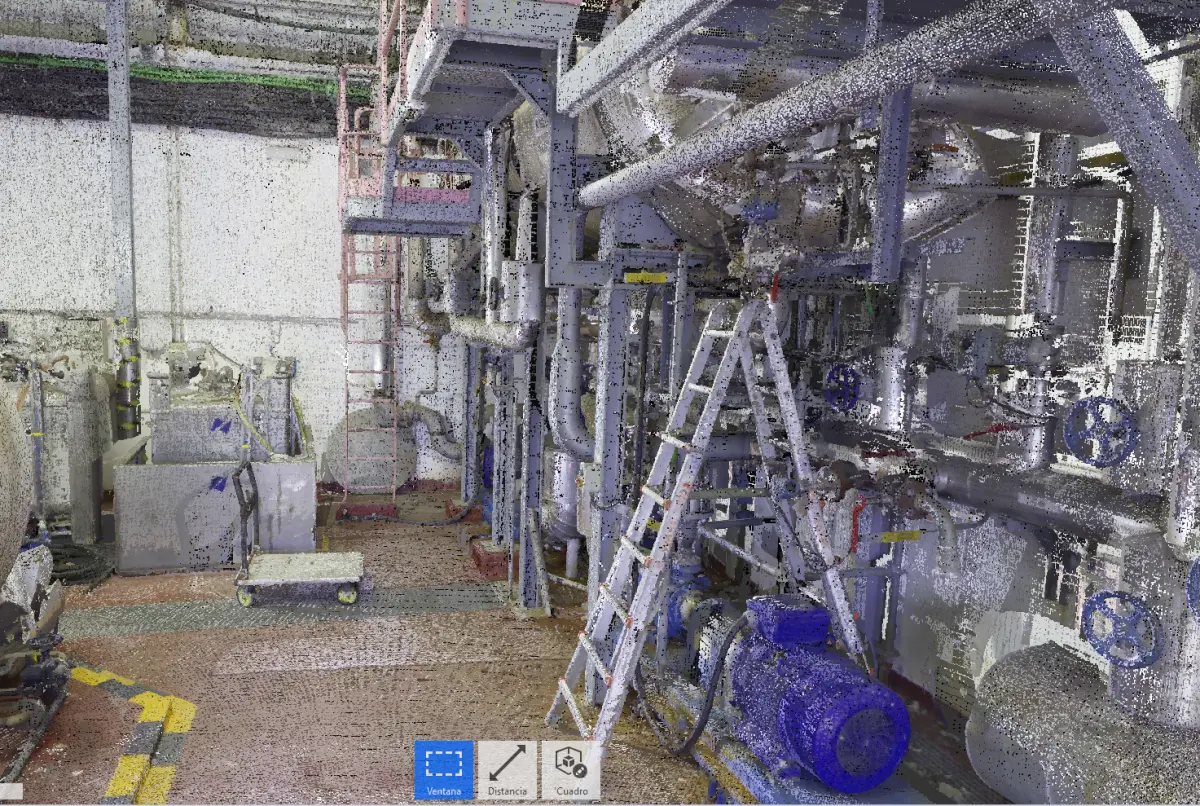
Why petrochemical plants need 3D laser scanning
A petrochemical plant is not a conventional industrial building. The density of elements per square metre is extraordinarily high: process lines of different diameters and materials, control valves, instrumentation, pipe supports at multiple levels, heat exchangers, distillation columns, reactors, furnaces, compressors, storage tanks, and a network of cable trays and instrumentation connecting the whole complex. Documenting this reality with a tape measure and a notebook —or even with a conventional laser distance meter— is unfeasible.
In addition to the geometric complexity, other factors make 3D laser scanning the only reasonable solution for obtaining reliable documentation of these facilities:
- Ageing infrastructure: many petrochemical plants in Spain were built in the 1970s, 1980s and 1990s. They have accumulated decades of partial modifications —equipment replacements, pipe rerouting, structural reinforcements, capacity expansions— that were never documented with the necessary rigour. The original drawings, if they exist, reflect a plant that no longer exists.
- Operational safety: any intervention in a process plant with flammable, toxic or high-pressure substances requires detailed planning. 3D laser scanning provides the exact dimensional information that safety teams and operations departments need to plan work without risk.
- Regulatory compliance: industrial safety regulations (Seveso III, RD 840/2015 on major accidents, ATEX regulations) require up-to-date facility documentation. An as-built model generated by 3D laser scanning provides this documentation with a level of detail and reliability that traditional methods cannot match.
- Cost of unplanned shutdowns: in a refinery, every hour of unplanned downtime can mean losses of tens of thousands of euros. Having accurate and up-to-date documentation reduces the risk of incidents that cause shutdowns, allows better planning of maintenance interventions, and shortens the duration of planned shutdowns.
We have described similar situations in our article on the 5 situations where your factory needs 3D scanning, where a plant without updated drawings and preparation for refurbishments are two of the most common scenarios.
Applications of 3D laser scanning in petrochemical plants
As-built documentation of piping systems
This is the most requested application. The piping networks of a petrochemical plant are its circulatory system: they connect process equipment, transport raw materials, intermediate products, final products, auxiliary services (steam, cooling water, instrument air, nitrogen) and effluents. Accurately documenting the routing, diameter, material, slope and position of each line is fundamental for any modification or expansion project.
3D laser scanning captures the complete geometry of all visible piping, including supports, valves, fittings, flanges and equipment connections. From the point cloud, our specialists model each line in AutoCAD Plant 3D or other piping software, generating a 3D model that exactly reflects what is in the plant. This model can be used directly as a basis for designing new lines, verifying existing routings, or generating as-built isometrics. If you want to learn more about this process, we recommend our guide on how to convert a point cloud into a CAD model.
Clash detection before installing new equipment
When a petrochemical plant needs to install a new heat exchanger, replace a compressor with a higher-capacity one, or add a new process line, the risk of clashes with existing elements is very high. The density of piping, cable trays, structure and equipment in these facilities means that any new element has to fit into an already very occupied space.
The as-built model generated from 3D laser scanning allows the design of the new equipment or new line to be superimposed on the existing reality and collisions to be detected before construction begins. In process plants, where a clash discovered during installation can delay a planned shutdown by weeks (with the cost that implies), this anticipation capability alone justifies the investment in scanning. We have explained this concept in detail in our article on Scan to BIM for industrial plants.
Planning of planned shutdowns (turnarounds)
Planned maintenance shutdowns —known as turnarounds in the petrochemical sector— are logistically enormously complex operations. During a limited period (typically between 2 and 6 weeks), inspections, repairs, equipment replacements, heat exchanger cleaning, refractory repair and all maintenance tasks requiring the unit to be out of service must be carried out simultaneously.
Having an up-to-date 3D model of the plant allows each intervention to be planned with exact knowledge of real conditions: access routes for cranes and lifting equipment, available spaces for spool pre-fabrication, exact position of flanges where cuts will be made, available heights for scaffolding, and material staging areas. A shutdown well planned on accurate documentation is executed faster and with fewer surprises —and in a planned shutdown, every day of advance means significant savings.
Deformation monitoring of tanks and pressure vessels
Large storage tanks and pressure vessels are subject to thermal cycles, internal pressures, ground settlement and corrosion that can cause progressive deformations. 3D laser scanning captures the exact geometry of these elements and compares it with the nominal design geometry or with previous scans to detect and quantify deformations: shell ovality, differential settlement of bottoms, plate buckling, nozzle displacements.
This information is critical for inspection departments and for the collaborating entities that carry out regulatory inspections of pressure equipment under the Pressure Equipment Regulation (RD 709/2015). Periodic scanning establishes a baseline and monitors the evolution of deformations over time.
Verification of safety zones and HAZOP study
HAZOP (Hazard and Operability) studies and risk analyses require precise information about distances between equipment, evacuation routes, position of fire protection systems, ventilation of classified zones and accessibility to emergency valves. The 3D model generated by scanning allows verification that safety distances between equipment comply with regulations, that evacuation routes are free of obstacles, and that protection systems are accessible.
In plants classified under Seveso (upper or lower threshold), this documentation is especially relevant for the preparation and updating of the Safety Report required by RD 840/2015.
Documentation for regulatory compliance
Petrochemical plants are subject to an extensive regulatory framework: Seveso III directive, ATEX regulations, Pressure Equipment Regulation, environmental regulations (emissions, discharges, contaminated soils), industrial safety regulations, and the operator's internal standards. Many of these regulations require up-to-date facility documentation, and inspections by control bodies (OCA) verify that the documentation reflects reality.
A complete 3D laser scan of the plant generates a documentary base that serves multiple regulatory purposes: updated as-built drawings, verification of safety distances, documentation of modifications made, and dimensional records of equipment and installations. It is an investment that pays for itself over multiple regulatory cycles.
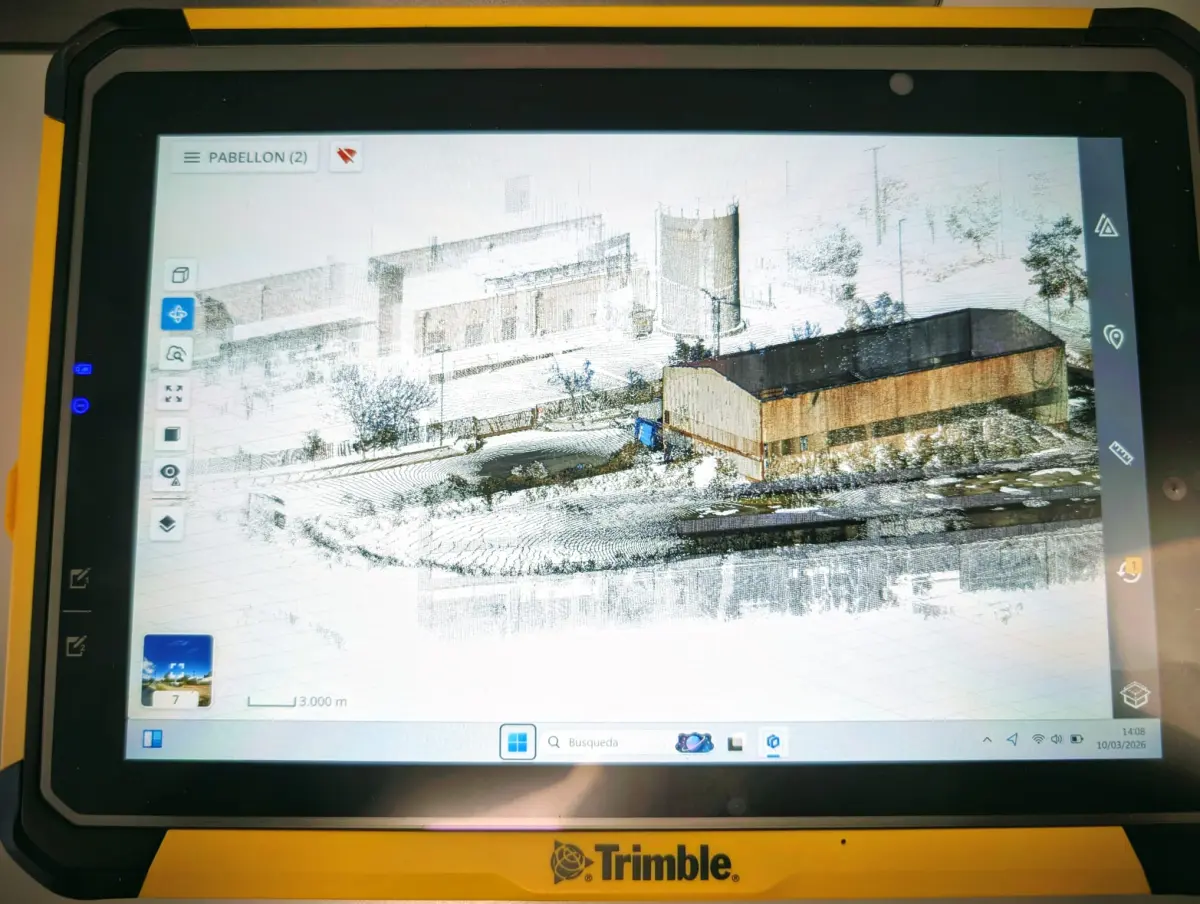
Equipment: Trimble X7 terrestrial laser scanner
For 3D laser scanning of petrochemical plants and refineries, we use the Trimble X7 terrestrial laser scanner, equipment particularly suited to this type of facility for several reasons:
- Measurement range of up to 80 metres: fundamental in petrochemical plants where distances between positioning points can be large, especially in tank farms, flare areas and long pipe racks.
- Outdoor use: unlike other scanning systems, the Trimble X7 works perfectly in outdoor conditions with direct sunlight, wind and variable temperatures, conditions common in petrochemical plants where most of the facility is exposed to the elements.
- Accuracy of ~4 mm at 10 m: sufficient to document piping, structure and equipment with the detail needed for modification projects and clash detection.
- Auto-levelling and automatic registration: significantly speeds up fieldwork, which is important in plants where access time to certain areas may be limited for operational or safety reasons.
- Portability: the equipment can be carried by hand up stairs, along platforms, through narrow corridors and into hard-to-reach areas, allowing scanning positions that heavier equipment could not reach.
- Does not generate sparks or flames: the operating principle of the laser scanner (emission and reception of infrared light) does not generate ignition sources, allowing its use in proximity to ATEX classified zones with appropriate safety protocols.
Scanning is performed without contact with the installations and without interfering with plant operations. In the vast majority of cases, scanning can be carried out with the plant in operation, avoiding the need for specific shutdowns for data collection. To complement the terrestrial scanner, we also have portable 3D scanning equipment for capturing detail of parts, nozzles, valves and elements with complex geometry.
Project deliverables
In a 3D laser scanning project of a petrochemical plant, deliverables are tailored to the specific needs of the client. The most common are:
Processed and navigable point cloud
The unified, clean and georeferenced point cloud is a deliverable in itself. It contains millions of points with XYZ coordinates and colour (RGB) representing the complete geometry of the scanned facility. It is delivered in standard formats (.e57, .rcp/.rcs, .las) compatible with most engineering software. It allows virtual navigation through the plant, measurement between any pair of points, and serves as a visual reference for project, operations and maintenance teams.
3D piping model
This is the highest-value deliverable in petrochemical projects. From the point cloud, each pipe line is modelled with its nominal diameter, three-dimensional routing, fittings (elbows, tees, reducers, flanges), valves, supports and equipment connections. The model is typically delivered in AutoCAD Plant 3D, although it can also be generated in Solid Edge and other CAD software according to client needs. As-built isometrics, bills of materials and installation documentation can be extracted from this model.
P&ID verification
A particularly relevant deliverable in process plants is the comparison between existing P&IDs (Piping and Instrumentation Diagrams) and the reality captured by the scanner. Our specialists identify discrepancies between existing documentation and what is actually in the plant: lines missing from the P&ID, routings that have changed, valves that have been added or removed, equipment that has been replaced with different specifications. The result is a discrepancy report that allows the P&IDs to be updated with the actual condition of the facility.
2D as-built drawings
For clients who need documentation in traditional format, floor plans, sections, elevations and details are generated in AutoCAD (.dwg) from the 3D model. These drawings reflect the actual condition of the plant and can be used as reference documentation, as a basis for modification projects, or as documentary support for regulatory inspections.
For more information on budgets and factors influencing cost, see our guide on how much industrial 3D scanning costs.
Safety in scanning: ATEX zones and non-contact work
Safety is the absolute priority in any work within a petrochemical plant. 3D laser scanning has a fundamental advantage over other data capture methods: it is completely non-intrusive. The scanner is positioned at a distance from equipment, requires no physical contact with any element of the facility, generates no vibrations, emits no heat, and produces no ignition sources.
These characteristics make laser scanning particularly suitable for plants with classified zones under the ATEX directive (explosive atmospheres). In practice, the working protocol we follow includes:
- Prior assessment of classified zones: before fieldwork begins, we review the plant's area classification to identify ATEX Zones 0, 1 and 2 and define the access and working protocols for each.
- Coordination with plant safety: all fieldwork is carried out under the supervision and coordination of the operator's safety department. We comply with the plant's work permit system (cold work permit, in this case) and with the coordination of business activities procedures.
- Specific PPE: the field team uses the PPE required by the plant: anti-static clothing, certified safety footwear, hard hat, safety glasses, portable gas detector when required, and any other element demanded by the operator's internal regulations.
- No dismantling or handling: unlike inspection methods that require opening equipment, removing insulation or accessing confined spaces, laser scanning captures what is visible from accessible positions. No element of the facility is handled.
This non-intrusive approach has an additional advantage: it minimises personnel exposure to plant hazards. A technician with the positioned scanner takes minutes to capture millions of points that, with traditional methods, would require hours of manual measurement in potentially hazardous areas.
Frequently asked questions
Can a petrochemical plant be scanned in an ATEX zone?
Yes, with the appropriate measures. The Trimble X7 terrestrial laser scanner does not generate sparks or flames, allowing its use in proximity to ATEX classified zones. For ATEX Zone 1, a prior risk assessment is required and, in some cases, the use of Ex-certified equipment or scanning during planned shutdowns with the plant degassed. In ATEX Zone 2 (occasional risk), scanning can typically be performed using standard safety protocols and coordination with the plant manager.
How long does it take to scan a complete petrochemical plant?
The field scanning time depends on the size and complexity of the plant. A medium-sized process unit (5,000 to 15,000 m²) may require 3 to 7 days of fieldwork, with several dozen or hundreds of scanning stations. Subsequent office modelling of piping and equipment may take 4 to 8 weeks depending on the level of detail required. Larger plants are tackled in phases or areas to facilitate project management.
What accuracy is achieved in 3D laser scanning of industrial piping?
With the Trimble X7 terrestrial laser scanner, the typical accuracy is approximately 4 mm at 10 metres distance. This is sufficient for as-built documentation of process piping, clash detection and dimensional verification of equipment. For pipes with a diameter greater than 2 inches, the capture reliably identifies the nominal diameter, position of supports, valves and fittings. Pipes with a diameter below 1 inch may require higher scanning density or supplementary manual measurement.
Can a P&ID be verified with the scanning point cloud?
The point cloud allows verification of the existence, position and routing of pipe lines represented in a P&ID, as well as the position of main equipment and the presence of visible valves, instrumentation and fittings. However, the point cloud does not capture process information (flow rates, pressures, temperatures) nor can it identify the contents of a closed pipe. Verification consists of comparing the actual physical topology with that represented in the diagram, identifying discrepancies such as missing lines, modified routings or relocated equipment.
3D laser scanning for your petrochemical plant or refinery
From Erandio (Bizkaia), we travel to petrochemical plants, refineries and industrial complexes in the Basque Country, Cantabria, and throughout Spain. We work with the Trimble X7 for capturing process facilities and complement with our portable 3D scanning equipment for elements requiring higher resolution.
If you need up-to-date as-built documentation of your plant, plan a shutdown with reliable dimensional information, or verify the actual condition of your facilities against existing documentation, we can help. Also check our 3D scanning of industrial facilities service to learn the full scope of what we offer.
Tell us about your project and we will prepare a tailored proposal. You can write to us from our contact page or call us at 946 49 00 27. We will respond within 24 hours with an initial assessment.