

October 16, 2025
How much does an industrial 3D scanning service cost (and what determines the price)
If you are considering hiring an industrial 3D scanning service, you have probably encountered a common problem: very few companies publish indicative rates. In this article we want to be transparent and help you understand what factors determine the price of industrial 3D scanning, what investment ranges you can expect and what exactly is included in a professional quote.
Why 3D scanning prices are so opaque
Unlike other industrial services with more standardised rates, the price of an industrial 3D scanning service varies enormously from one project to another. Scanning a 20-centimetre part in a laboratory is not the same as digitising a complete 5,000 square metre production plant.
This variability means many companies avoid publishing prices. We believe that creates mistrust. An engineering or maintenance manager needs at least an order of magnitude to know whether the service fits their budget before requesting a formal quote. That is why we have prepared this guide with indicative 3D scanning rates in Spain and the key factors that determine them.
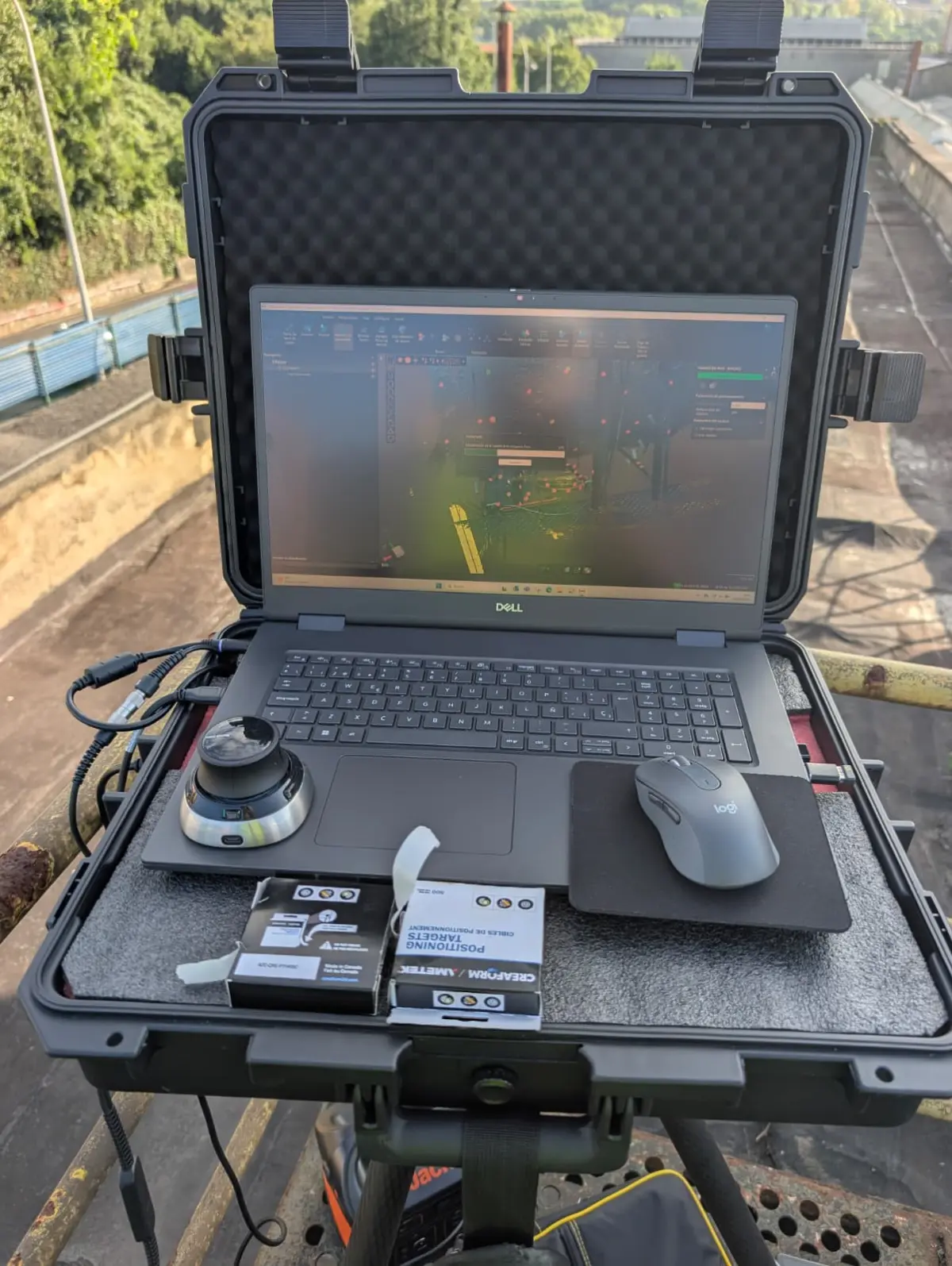
The 6 factors that determine the price of a 3D scan
1. Size and complexity of the part or space
This is the most obvious factor. A simple mechanical part with basic geometry requires less capture and processing time than a component with internal cavities, organic surfaces or reflective finishes. Likewise, a laser scan of industrial facilities covering a 200 m2 room does not have the same scope as scanning an entire plant with multiple levels and hard-to-reach areas.
As a general rule: the larger the size and the greater the geometric complexity, the more scanner positions are needed and the more processing time is required, which increases the cost.
2. Required precision
Not all projects need the same tolerance. A scan for visualisation or documentation can work with 1-2 mm precision, while a reverse engineering project to manufacture a spare part may require the maximum equipment precision (+/-0.15 mm with our portable Creaform HandyScan MAX scanner). The higher the required precision, the more exhaustive the capture, verification and post-processing process.
3. Type of deliverable
The final result you need has a direct impact on the price. The most common options, from lowest to highest processing cost, are:
- Point cloud: the raw scanner data, useful as a visual reference or for point measurements.
- STL mesh: triangulated surface, suitable for 3D printing, visual analysis or digital archiving.
- Solid CAD model (STEP, IGES, Parasolid): the most demanded deliverable for reverse engineering and manufacturing. Requires expert parametric modelling work.
- 2D drawings: technical documentation with dimensions, sections and views from the 3D model.
A part digitisation delivered as an STL mesh is significantly more affordable than the same scan with a fully parametrised solid CAD model. If you need to reach the CAD model because your objective is to manufacture spare parts, see our guide on how to digitise a part without original drawings. For dimensional quality control projects, the deliverable is usually a deviation report with a colour map, without the need for a full CAD model.
4. Need for travel
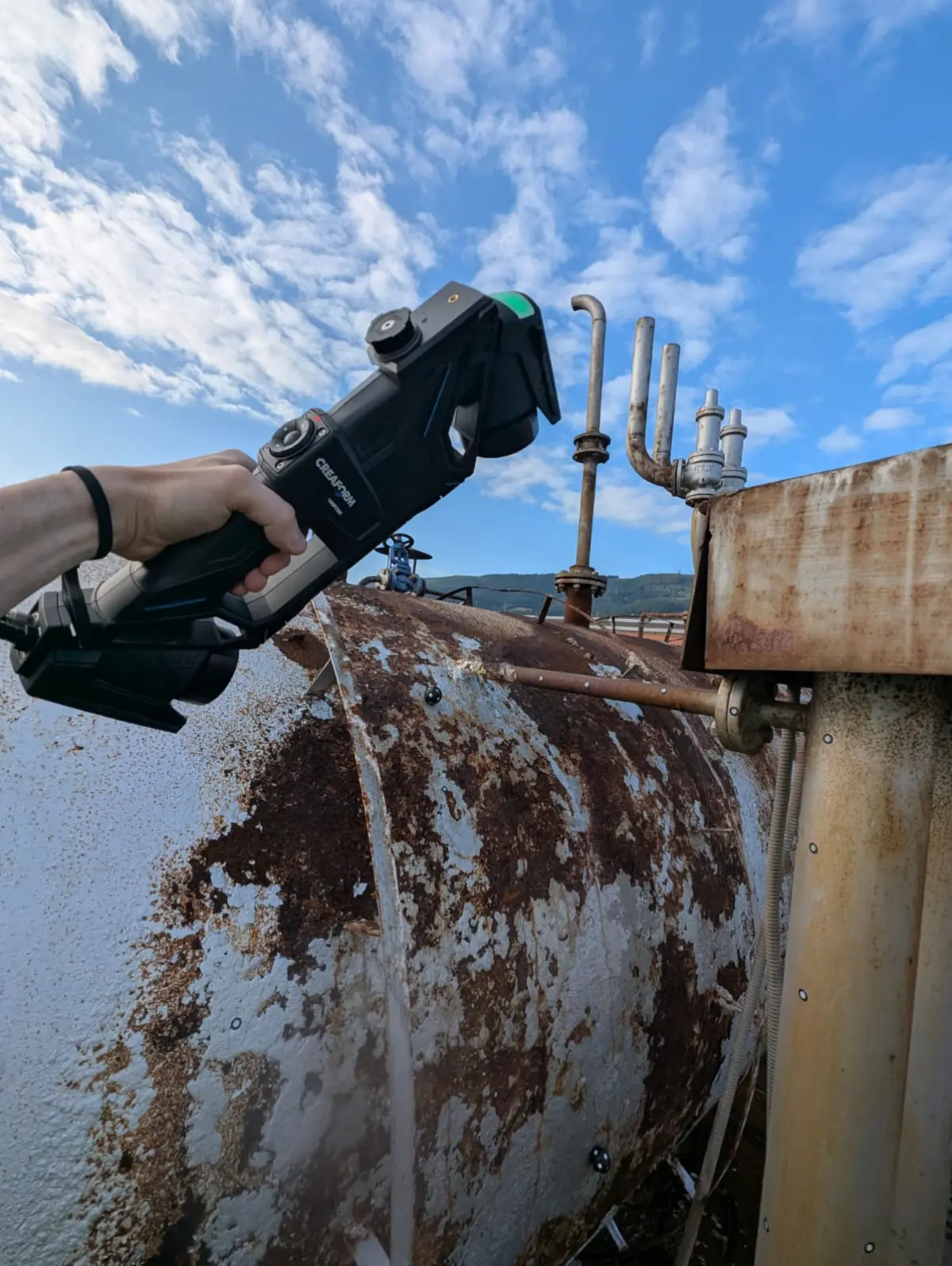
When the part or facility cannot be transported to our offices, the team travels to the client's location. On-site industrial 3D laser scanning has an additional cost associated with equipment transport, expenses and travel time. At PROMECAD we regularly operate throughout the Basque Country and northern Spain without the surcharge being significant. For large-scale projects anywhere on the peninsula, the travel cost is diluted in the total project cost.
5. Volume: single part, batch or complete plant
Work volume has a direct effect on unit price. Scanning a single part involves preparation, calibration and configuration that is amortised over that unit alone. However, when dealing with a batch of similar parts or a complete 3D facility scanning project, fixed costs are spread and the price per element drops considerably. If you need to identify whether your case justifies the investment, you may find our article on 5 situations where your factory needs 3D scanning useful.
6. Urgency
Standard delivery times range from 5 to 15 working days depending on complexity. If you need results within 24-48 hours (for example, due to a production shutdown), it is possible to prioritise your project, although this involves an urgency surcharge that can range from an additional 25% to 50%.
Indicative price ranges by project type
The following table shows typical price ranges for industrial 3D scanning projects in Spain. These are indicative values that may vary depending on the factors described above. All amounts exclude VAT.
| Project type | Includes | Indicative range |
|---|---|---|
| Single part — STL mesh | Scanning + processing + optimised mesh | From €400 |
| Single part — solid CAD model | Scanning + mesh + parametric CAD modelling | €500 to €1,500 |
| Single part — CAD + 2D drawings | All of the above + dimensioned 2D documentation | €700 to €2,000 |
| Batch of parts (5-20 units) | Scanning + deliverable as required | Unit price reduced 20-40% |
| Facility — point cloud | Laser scanning + registration + clean point cloud | From €1,500 |
| Facility — point cloud + as-built model | Point cloud + 3D modelling + floor plans | From €3,500 |
| Complete plant (>2,000 m2) | Full scanning + complete as-built | From €8,000 (scope dependent) |
Facility projects with an as-built model correspond to the Scan to BIM workflow for industrial plants, where the point cloud is converted into a navigable model in Revit or AutoCAD Plant 3D. For part reverse engineering projects, the range depends fundamentally on geometric complexity and the level of documentation required.
Important note about these prices
These figures are indicative and correspond to typical projects. An exact industrial 3D part scanning quote requires knowing the specific details of your project. At PROMECAD we send personalised quotes within 24 hours, with no obligation and with the scope clearly detailed.
What PROMECAD's 3D scanning service includes
A key aspect when comparing quotes from different providers is understanding what a professional 3D scanning service includes. Not all quotes cover the same phases. In our case, a typical industrial 3D scanning project includes:
- Initial consultation and scope definition: we analyse with you the objectives, required tolerances and optimal delivery format. This phase is free and allows us to correctly size the project.
- Preparation and planning: selection of appropriate equipment, capture strategy and, if necessary, surface preparation (targets, anti-reflective spray).
- Data capture: scanning at our facilities or travel to your plant. We use state-of-the-art equipment for both 3D part scanning (portable blue laser Creaform HandyScan MAX) and laser facility scanning (long-range terrestrial laser).
- Data processing: registration, alignment, noise cleaning, mesh generation and, where applicable, parametric CAD modelling and/or drawing preparation.
- Delivery and review: we send files in the agreed formats together with a quality report. We include one round of revisions for minor adjustments at no additional cost.
What sets us apart
At PROMECAD we do not just scan: we are specialists in industrial mechanical design with over 20 years of experience, which allows us to interpret the captured geometry and convert it into CAD models that are truly useful for manufacturing, not merely aesthetic shells. If your goal is reverse engineering or spare part manufacturing, this experience makes the difference.
How to request a 3D scanning quote (and what information we need)
So that we can offer you a precise industrial 3D part scanning quote with no surprises, it is helpful if you provide the following information when you contact us:
- Description of the object or space: what you want to scan, its approximate dimensions and, if possible, some photographs.
- Project objective: reverse engineering to manufacture spare parts, as-built documentation, dimensional control, digital archiving, etc.
- Desired delivery format: point cloud, STL mesh, solid CAD model (STEP, IGES, native), 2D drawings...
- Required precision: if you know it, tell us the necessary tolerance. If you are unsure, we will advise you.
- Location: whether the part can be shipped or if you need an on-site scanning service at your plant.
- Timescale: standard or urgent.
- Volume: number of parts or extent of the facility.
Do not worry if you do not have all the information. It is common for us to have an initial call or video call to properly understand the project before quoting.
Frequently asked questions about 3D scanning pricing
Is there a minimum cost per project?
Yes. Due to preparation, calibration and processing costs, single-part projects rarely go below 400 euros. For facilities, the practical minimum is usually around 1,500 euros. These thresholds ensure a professional and rigorous result.
Is it cheaper to send the part to your laboratory?
Generally yes, because travel costs are eliminated. If the part is transportable and is not integrated into operating equipment, we recommend this option. For large parts, installed machinery or complete facilities, on-site travel is the only alternative and is included in the quote.
How much does an urgent industrial 3D scan cost?
It depends on the workload at the time, but the typical urgency surcharge (delivery in 24-48 hours instead of the standard timeframe) ranges from 25% to 50%. If you have a production shutdown, do not hesitate to contact us: we prioritise these cases.
Can I hire just the data capture without the processing?
Yes. Some clients with their own engineering teams prefer to receive only the point cloud or mesh and handle the CAD modelling internally. In these cases, the price is significantly reduced.
Transparency as a principle
We know that understanding 3D scanning rates in Spain before contacting a provider helps make better decisions. That is why we have aimed to be clear and direct in this article. Every project is different, but we trust that this guide has given you a realistic expectation of the investment involved.
If you already know what you need, or if you want us to help you define it, request a no-obligation quote. We will respond within 24 hours with a detailed proposal, no fine print and with the scope perfectly defined.