

September 25, 2025
3D Scanner vs CMM: When to Use Each Technology in Quality Control
In industrial quality control, two technologies constantly come up in conversation: the coordinate measuring machine (CMM) and the 3D scanner. Both measure parts, both generate dimensional reports, but they work in radically different ways and each has clear advantages in specific scenarios. If you are evaluating which one you need, or wondering whether a 3D scanner can replace your CMM, this article gives you a practical comparison based on our real experience with both technologies.
What is a CMM and what is a 3D scanner (for those who are not sure)
A CMM (Coordinate Measuring Machine) is a metrology device that uses a contact probe to touch specific points on a part's surface and record their X, Y, Z coordinates with very high precision. The part is placed on the CMM table and the probe moves —manually or automatically— to the points to be measured. It is like measuring with a digital calliper, but in three dimensions, with micron-level precision and the ability to verify complex geometric tolerances (GD&T).
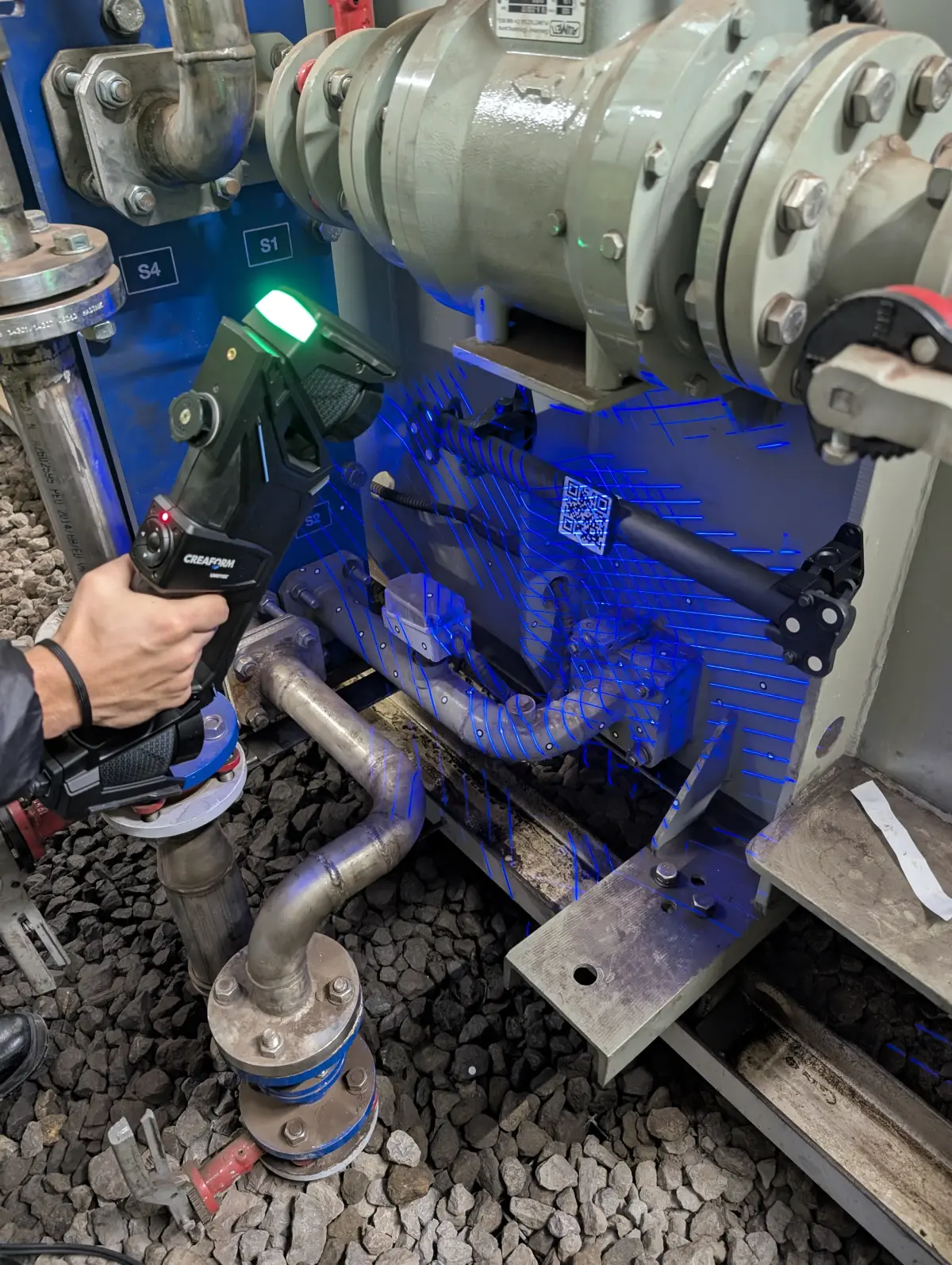
A 3D scanner, on the other hand, is a device that captures the part's geometry optically, without physical contact. It projects a light pattern (laser or structured light) onto the surface and, through cameras, calculates the three-dimensional position of each illuminated point. Instead of measuring individual points, it captures millions of points in a matter of minutes, generating a point cloud or polygonal mesh that represents the entire visible surface of the part.
The fundamental difference is not just about accuracy or speed: it is about approach. The CMM measures specific points with extreme precision. The 3D scanner captures complete surfaces with high resolution. They are different measurement philosophies, and understanding this difference is key to making the right choice.
Head-to-head comparison
Let's get to the point. This table summarises the most relevant differences between both technologies for industrial dimensional quality control applications.
| Criterion | CMM | 3D Scanner |
|---|---|---|
| Accuracy | ±0.002 to ±0.005 mm | ±0.15 mm (HandyScan MAX) |
| Measurement speed | Slow: point by point | Fast: complete surface in minutes |
| Points captured | Tens to hundreds per part | Millions per part |
| Portability | None: fixed equipment in climate-controlled room | Full: portable, taken to the shop floor |
| Complex geometries | Limited: requires many points | Excellent: captures freeform surfaces |
| Internal geometries | Yes, with special probes | No: visible surfaces only |
| Cost per part | High (programming + operator time) | Medium-low (fast scanning) |
| Fragile/flexible parts | Risk of deformation from contact | Non-contact: ideal |
| Visual output | Table of numerical values | Colour map + table of values |
| Part size | Limited to table volume | From mm to metres |
Accuracy
The CMM wins decisively in pure accuracy. A mid-to-high-end unit works with uncertainties of ±0.003 mm or better. The 3D scanner, even a professional unit like the HandyScan MAX we use at PROMECAD, has an accuracy of ±0.15 mm with 0.04 mm resolution. This means that for tolerances below ±0.05 mm, the CMM is the mandatory choice. For tolerances above ±0.1 mm (which represent the majority of industrial applications outside aerospace and high-precision sectors), the 3D scanner is more than sufficient.
Measurement speed
Here the 3D scanner's advantage is overwhelming. While a CMM measures a complex part in 30-60 minutes (and requires prior programming), the 3D scanner captures the entire surface in 5-15 minutes. If you need to inspect 20 parts in a morning, the productivity difference is enormous. This is one of the determining factors for reducing inspection times in production.
Number of points captured
A CMM typically measures between 50 and 500 points per part, depending on programme complexity. A 3D scanner captures millions of points. This has a direct implication: with the CMM, you only verify the dimensions you decided to measure; with the 3D scanner, you have information on the entire surface. If there is a defect in an area you had not planned to measure with the CMM, you will not detect it. With the 3D scanner, you will.
Portability
The CMM is fixed equipment, normally installed in a metrology room with controlled temperature. The part must go to the CMM. The 3D scanner, especially handheld portable devices, goes to the part. This allows on-site measurement, on the production line, in the incoming materials warehouse, or even at the supplier's premises. For very large parts or those installed in machines, portability is not a minor advantage: it is the only viable option.
Type of geometry
CMMs are optimised for prismatic geometries: planes, cylinders, cones, spheres. Measuring a freeform surface (organic, with complex curvatures) with a CMM requires a very large number of points and is slow and imprecise. The 3D scanner captures complex surfaces with the same ease as simple ones. For parts such as turbine blades, mould housings, body panels or composite components, the scanner is clearly superior. In the aerospace sector, for example, inspection of complex aerodynamic surfaces and composite components is one of the applications where the 3D scanner adds most value versus the CMM. For specific automotive applications, see our article on 3D scanning in the automotive industry.
Cost per part
CMM inspection cost includes programming time (which can be significant for the first part), qualified operator time and equipment depreciation. The 3D scanner drastically reduces preparation and operation time. For recurring inspections of complex parts, the saving per part can be 50% to 70%. For a broader perspective on costs, see our industrial 3D scanning pricing guide.
When the CMM is the best option
The CMM remains irreplaceable in several specific scenarios:
- Micrometric tolerances: any dimension with a tolerance below ±0.01 mm requires a CMM. Bearing fits, precision housings, machine tool shafts.
- Internal features: deep holes, internal grooves, cavities not visible from the outside. The CMM can access these with special probes (star, extension, angular).
- Regulatory requirements: some sectors or clients specifically require CMM reports. This is common in aerospace, defence and automotive OEM for safety-critical dimensions.
- Simple prismatic parts: if the part is a machined block with 10 dimensions between planes and 5 diameters, the CMM is direct and efficient. The 3D scanner would provide more information than necessary.
- Very long runs with programme already created: if you have a CNC CMM with the programme made, each part's inspection is automatic. The programming cost is amortised with volume.
When the 3D scanner clearly wins
The 3D scanner is the best choice —and often the only viable one— in these cases:
- Complex surfaces: housings, blades, moulds, dies, formed panels. Measuring these geometries with a CMM is slow, costly and captures only a fraction of the information. The scanner captures everything.
- On-site inspection: the part is mounted in a machine, is too large to take to the metrology room, or the supplier is in another region. The portable 3D scanner goes wherever needed. This portability is especially valuable in sectors like naval, where parts to be inspected are usually installed on vessels or in dry dock.
- Fragile or flexible parts: thin sheets, soft plastic parts, composite components, ceramic parts. Any part that deforms when touched needs non-contact measurement.
- Detection of unforeseen problems: by capturing the entire surface, you can discover defects that were not in the inspection plan. Welding distortions, injection sink marks, shape deviations not visible to the naked eye.
- High inspection volume: if you need to verify many parts in a short time, the 3D scanner multiplies productivity. In our article on the 5 situations where your factory needs 3D scanning, we detail more real scenarios.
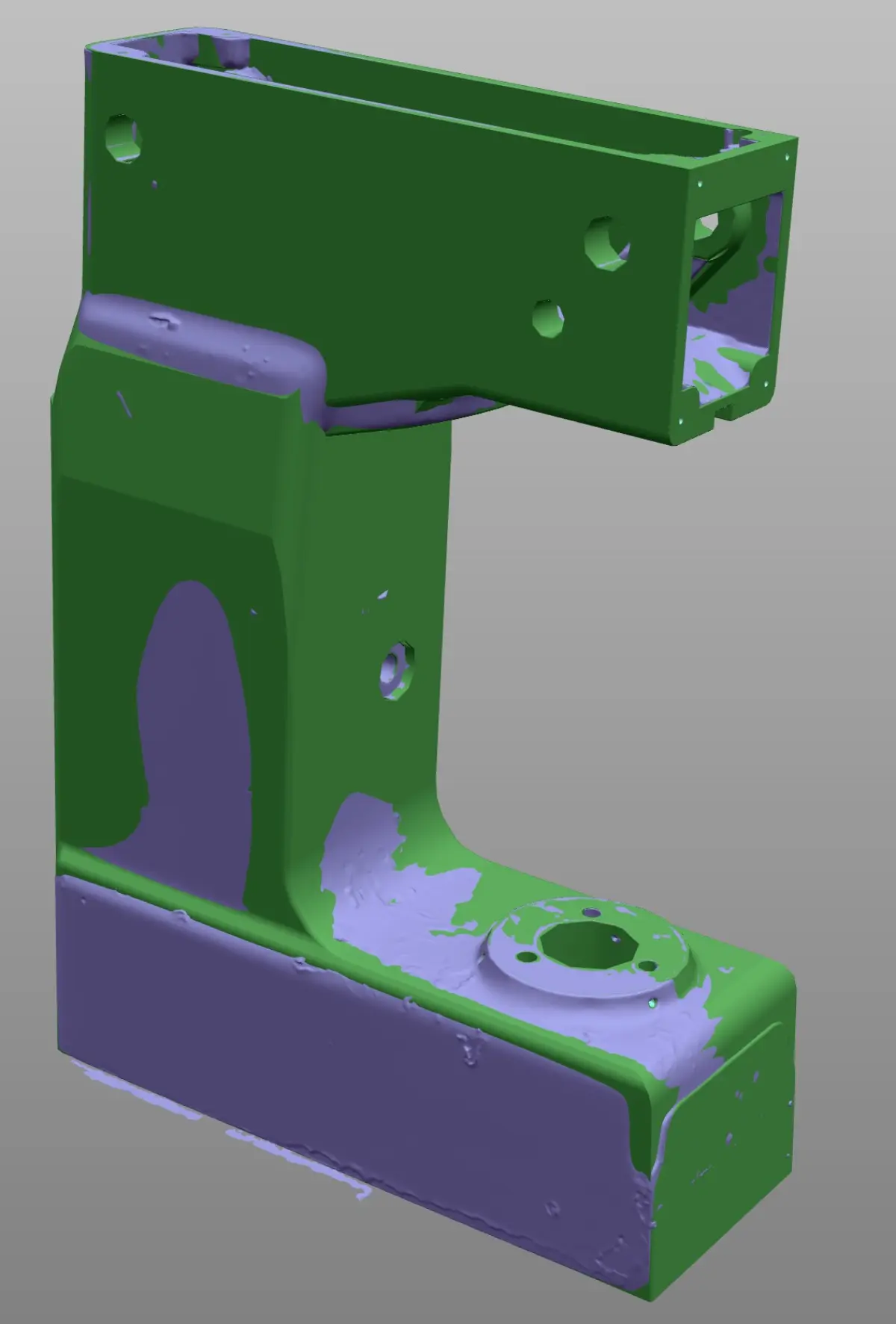
- Visual communication: the 3D scanner's colour map allows anyone, technical or not, to understand where the problem is. It is a communication tool between departments, with suppliers and with clients.
They are not mutually exclusive: when to combine both
In practice, the most advanced factories in quality control do not choose between CMM and 3D scanner: they use both. The most efficient strategy is usually:
- 3D scanner for global inspection: verifying the overall part profile, detecting deformations, generating the deviation map as a first screening. This is done quickly and gives a complete picture.
- CMM for critical dimensions: measuring with micrometric precision bearing housing diameters, centre distances, or any dimension where the tolerance does not allow the scanner's uncertainty.
This combined approach optimises total inspection time: the 3D scanner quickly filters out parts with obvious problems, and the CMM is reserved for verifying the most demanding dimensions only on parts that have passed the first screening. The result is a faster, more complete, and paradoxically more economical inspection process than using CMM alone.
At PROMECAD, when we carry out 3D scanning of parts projects for quality control, we always indicate to the client which dimensions can be verified with the scanner and which would need supplementary CMM. That transparency is part of our service.
Case study: factory that reduced inspection times by 70%
Quality control transformation at a tooling manufacturer
Sector: Stamping tooling manufacturing — Situation: 15-20 new parts per month, each with complex geometries and formed surfaces.
Before: Each new part required programming the CMM from scratch (2-3 hours of programming) and running the measurement (1-2 hours). The metrology room bottleneck delayed deliveries by an average of 3 days. Only drawing dimensions were verified; surface defects were detected, if at all, during final assembly.
After (with 3D scanner): Complete scanning of each part takes 10-15 minutes. The deviation map against CAD is generated in less than 30 minutes. Critical dimensions of bearing housings are still measured with the CMM, but that targeted measurement takes only 15-20 minutes because the full surface no longer needs to be programmed.
Result: Total inspection time per part went from 3-5 hours to 45-60 minutes. Inspection capacity tripled without expanding the quality department. Additionally, shape defects that previously went unnoticed began to be detected, which reduced rework during assembly.
Frequently asked questions
Can a 3D scanner completely replace a CMM?
Not in all cases. The 3D scanner surpasses the CMM in speed, portability and ability to capture complex geometries, but the CMM is still necessary when tolerances are very tight (below ±0.01 mm) or when measurements of internal features inaccessible to the scanner are needed. Many companies use both technologies in a complementary way.
How much does a 3D scanner inspection cost compared to a CMM?
The cost per part with a 3D scanner is usually lower than with a CMM, especially when the part has complex geometries requiring many measurement points. The CMM requires prior programming and more operator time, which increases the unit cost. However, for simple parts with few dimensions, the CMM can be equally economical.
Is a 3D scanner inspection report valid for quality certification?
Yes, inspection reports generated with a 3D scanner are fully valid for quality documentation, audits and ISO 9001 certifications. The 3D scanner is a calibrated and traceable metrology instrument. Some very specific sectors (aerospace, nuclear) may additionally require complementary CMM measurements for certain critical dimensions.
What about internal geometries that the scanner cannot see?
The 3D scanner captures visible external surfaces. For internal features such as deep holes, internal channels or closed cavities, it needs to be complemented with a CMM (contact probe), industrial computed tomography (CT scan) or 3D boroscopy. In practice, most industrial inspections are resolved with a 3D scanner for external surfaces and targeted CMM for critical internal dimensions.
We help you decide the best solution for your case
If you are not sure whether you need a 3D scanner, CMM, or both for your dimensional inspections, we can help. At PROMECAD we have more than 20 years of experience in industrial mechanical design and we have professional 3D scanning equipment to address your quality control needs. We analyse your part type, your tolerances and your inspection volume, and recommend the most efficient solution.
We operate from Erandio (Bizkaia), travel to your facility and deliver complete dimensional reports. Tell us about your specific case and we will advise you with no obligation.
Contact us or call us at +34 94 406 42 83.