

March 6, 2026
3D metrology and scanning in the food industry: applications and advantages
The food industry works with equipment that combines complex geometries, reflective materials and extreme hygienic requirements. AISI 316 stainless steel mixing tanks without original drawings, CIP piping lines that have been modified dozens of times without updating the documentation, thermoforming molds for packaging that need periodic verification. The 3D metrology service for the food industry allows capturing with precision the real geometry of all these elements, generating reliable documentation to manufacture spare parts, plan expansions or comply with the quality audits that the sector demands.
The specific challenges of the food and beverage industry
Any food processing plant —whether a canning factory, a bottling plant, a dairy facility or a ready-meals line— shares a series of characteristics that condition any metrology or 3D digitization work.
First, the materials. The vast majority of equipment in contact with the product is made of austenitic stainless steel (AISI 304 or AISI 316L), chosen for its corrosion resistance and food-grade suitability. These steels have polished or satin-finished surfaces that are highly reflective, which poses a technical challenge for conventional laser scanners. Capturing geometry with precision on surfaces that reflect the light beam requires specific techniques that we detail further on.
Second, hygiene. Food safety standards (IFS, BRC, FSSC 22000) impose strict restrictions on what can enter a production area and what can touch surfaces in contact with food. Any measuring equipment entering a clean room or production zone must comply with cleaning protocols and must not leave residues that compromise product safety.
Third, deadlines. Food plants operate with continuous or semi-continuous production, and shutdowns are expensive. Any scanning work must be planned to take advantage of scheduled maintenance windows, weekend shutdowns or intervals between production runs. There is no room for work that drags on or requires unplanned equipment disassembly.
And finally, legacy documentation. It is extraordinarily common to find plants that have been operating for 20 or 30 years and whose original drawings —if they ever existed— no longer reflect reality. Expansions, line modifications, equipment replacements: all of this creates a growing gap between the documentation and the actual facility. If you find yourself in this situation, you will be interested in our guide on how to digitize a part without original drawings.
3D metrology applications in food plants
The 3D metrology service for the food industry ranges from digitizing a single component to the complete survey of a production line. These are the most frequent applications we carry out at PROMECAD.
Digitization of tanks, mixers and reactors
Storage tanks, agitated mixers and reactors are the heart of any food processing plant. Many of them were custom-built decades ago and do not have up-to-date technical documentation. When a spare part needs to be manufactured —a lid, a connection flange, an agitator— or when the tank needs to be integrated into a line expansion, the only reliable option is to scan the real geometry of the equipment and generate a CAD model from the captured data.
Our technicians digitize the complete tank including nozzles, supports, sanitary connections and all welded elements that define the real geometry. The result is a three-dimensional CAD model that allows manufacturing components with the certainty that they will fit the first time, without the need to travel to the plant multiple times to take manual measurements.
Scanning of molds for food packaging
The manufacture of food packaging —trays, tubs, blisters, lids— depends on thermoforming and injection molds that must maintain strict dimensional tolerances to guarantee sealing, stacking and compatibility with packaging lines. 3D scanning of food molds allows periodic verification of the condition of these tools and detection of wear before it causes production problems.
In our article on 3D scanning of injection molds we detail how wear control is carried out through deviation maps. The same principle applies to thermoforming and blow molding molds used in food processing, with the particularity that sealing and closure tolerances are critical for the safety of the packaged product.
Documentation of piping and valves for CIP systems
CIP (Clean-In-Place) cleaning systems are essential in any food plant. They consist of complex networks of pipes, valves, pumps and solution tanks that must be perfectly documented to ensure that all surfaces in contact with the product receive adequate cleaning.
The problem is that these installations are frequently modified —lines are added, valves are changed, circuits are rerouted— and the documentation is rarely updated at the same pace. 3D scanning allows generating a complete as-built model of the piping network, including actual diameters, slopes, distances between supports and the exact position of each valve. This documentation is essential for planning modifications, sizing new CIP circuits and meeting quality audit requirements. For installations of this type, we use our facility 3D scanning service with the Trimble X7 laser station.
Quality control of components: gaskets, fittings and custom parts
In a food plant there are hundreds of components that must fit precisely: O-rings, sanitary clamp fittings, adapters between equipment from different manufacturers, wear parts that are replaced periodically. When the original manufacturer no longer exists or when the part was custom-made, dimensional quality control with a 3D scanner is the most efficient way to verify that a manufactured replacement meets the dimensions of the original.
With our portable scanner, we capture the complete geometry of the original part and generate a dimensional report that serves as a reference for manufacturing the replacement. This is especially useful for machined stainless steel parts that must maintain the surface finish and fit tolerances required in food environments.
Planning expansions and retrofit of production lines
Food plants grow. New packaging lines are added, storage capacity is expanded, additional pasteurization or sterilization equipment is installed. The problem is that the available space in an industrial building is limited, and each new installation must coexist with the existing ones without generating interferences.
3D scanning of the existing facility generates a precise digital model of the available space, including equipment, structures, piping, ducts and all real obstacles. Project engineers can then design the expansion on that model with the assurance that the dimensions are correct and there will be no surprises during installation. Our facility 3D scanning service is specifically designed for this type of project.
Documentation for IFS, BRC and FSSC 22000 audits
International food safety standards require companies to maintain up-to-date technical documentation of their facilities and equipment. This includes floor plans, process flow diagrams, CIP network schematics and dimensional records of critical equipment. 3D scanning allows generating all this documentation from real data, eliminating dependence on old drawings that may not reflect the current state of the facility.
Having precise as-built documentation not only facilitates audits, but also demonstrates a commitment to traceability and process control that auditors value positively.
Equipment: from individual components to the complete plant
At PROMECAD we use complementary equipment that covers the full range of scales needed by the food industry.
For components and parts (gaskets, fittings, agitators, molds, flanges), we work with the Creaform HandyScan MAX portable scanner. This equipment offers an accuracy of ±0.15 mm and a mesh resolution of 0.04 mm, which allows capturing complex geometries in detail such as sanitary threads, fillet radii and sealing surfaces. It is fully portable and requires no setup: the technician scans directly at the plant, next to the equipment, without any disassembly needed.
For facilities and production lines (process rooms, piping networks, equipment layout in a building), we use the Trimble X7 laser station. This scanner captures millions of points per second and generates high-density point clouds that faithfully represent an entire industrial space. It is the right tool when you need to document the relative position of all equipment in a room, piping routes or available space for an expansion.
If you want to better understand how the complete scanning process works, we recommend our article on how industrial 3D scanning works.
Technical challenges specific to the food sector
Working in food plants involves solving a series of technical challenges that do not occur with the same intensity in other industrial sectors.
Reflective stainless steel surfaces
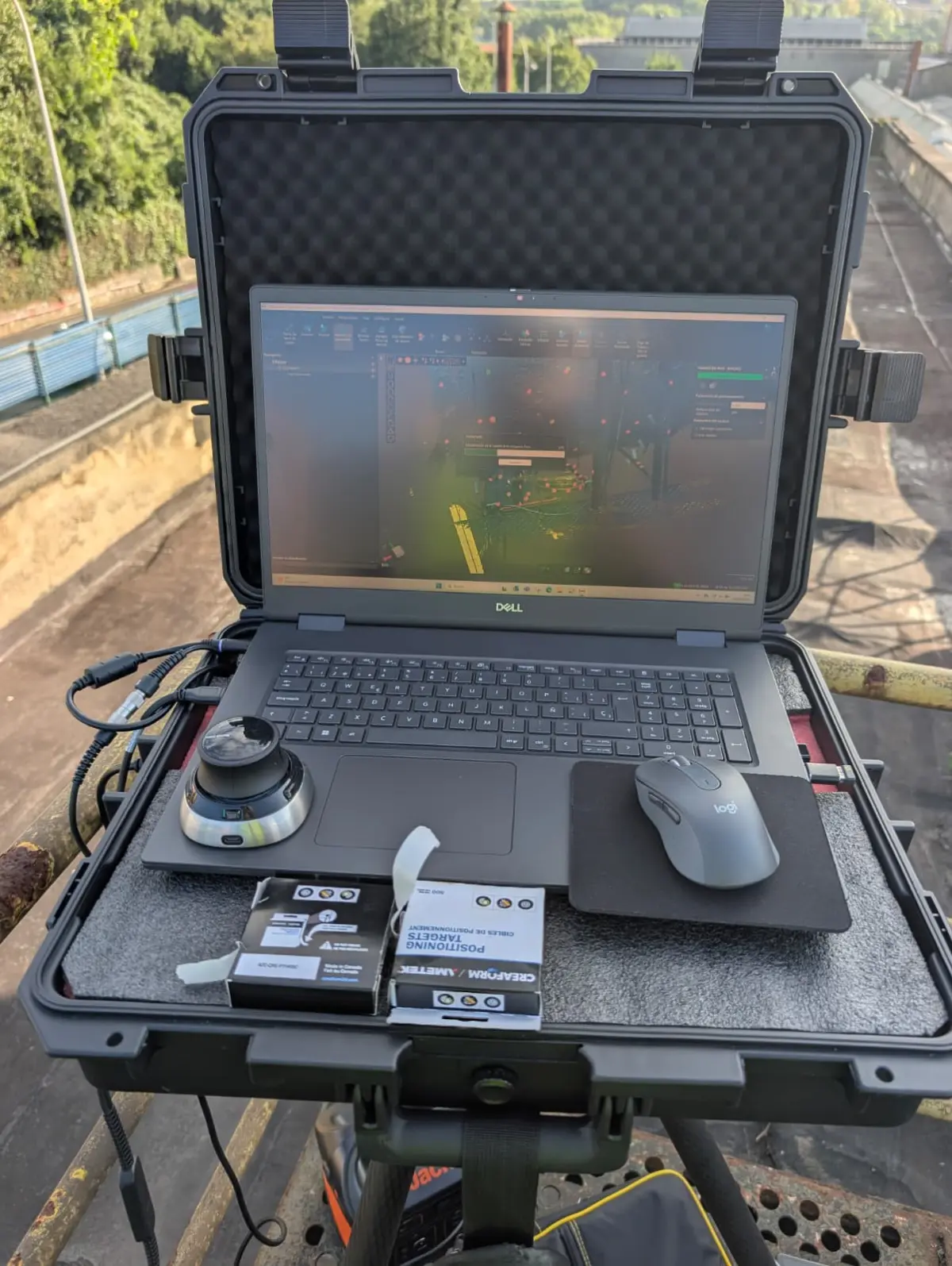
Polished stainless steel reflects the scanner's laser beam, which can generate noisy data or areas without capture. To solve this, we apply a temporary contrast developer spray that mattifies the surface during scanning. This spray is non-toxic, leaves no permanent residue and is easily removed with a dry cloth or water. In cases where even the spray is not permissible (surfaces in direct contact with product in active production areas), we use adhesive reference targets positioned in non-critical zones and adapted capture techniques.
Hygienic requirements and access to production areas
Our technicians follow each plant's hygiene protocols: specific PPE, disinfected footwear, clean equipment before entering the production area. All scanning equipment is disinfected beforehand according to the instructions of the plant's quality manager. We do not use substances or materials that could contaminate the production environment.
Reduced work windows
In many food plants, access to equipment is only possible during scheduled maintenance shutdowns, weekend shutdowns or intervals between different product runs. This demands prior planning and fieldwork efficiency. Our team arrives with the work prepared —we know what needs to be scanned, in what order and with which equipment— to make the most of every available hour.
Deliverables: what you receive as a result of the service
Each 3D metrology project in the food industry is tailored to the client's specific needs, but the standard deliverables include:
- 3D CAD models (Solid Edge, STEP, IGES) of the scanned equipment, ready for manufacturing spare parts, designing modifications or integrating into expansion projects.
- Dimensioned 2D drawings in DWG/PDF format, with the views, sections and details needed for manufacturing or technical documentation.
- Point clouds of the scanned facilities (E57, RCP formats), integrable into plant design software for retrofit planning.
- Dimensional reports with color deviation maps when the objective is quality control or wear verification.
- As-built documentation updated for IFS, BRC or FSSC 22000 audits.
Ultimately, the goal is for the client to receive reliable and actionable technical documentation that allows them to make informed decisions, whether to manufacture a part, plan construction work or pass an audit. For more information on costs, check our industrial 3D scanning price guide.
Frequently asked questions
Can polished stainless steel be scanned without damaging the surface?
Yes. Polished or satin-finished stainless steel surfaces are reflective, which makes direct capture with a laser scanner difficult. To solve this, we apply a temporary, non-contaminating contrast developer spray that is easily removed with a cloth or water, leaving no residue and not affecting the food-grade suitability of the equipment. On surfaces where even the spray is not feasible, we use adhesive reference targets that are also removed without a trace.
How long does it take to scan a tank or reactor in a food plant?
It depends on the size and geometric complexity. A 2–5 m³ mixing tank with agitator and nozzles is typically scanned in 2–4 hours. A larger reactor or one with complex internals (coils, baffles) may require a full day. Data processing and CAD model generation are carried out subsequently in the office and usually take between 2 and 5 working days depending on the scope.
Is 3D scanning useful for documenting facilities for IFS or BRC audits?
Yes. Both IFS and BRC require up-to-date documentation of production facilities, including as-built drawings and equipment records. 3D scanning generates precise and traceable dimensional documentation that complements the technical documentation required in these audits. The 3D models and drawings derived from the scan demonstrate the actual state of the facility and facilitate change management.
What is the approximate cost of a 3D metrology service for the food industry?
The cost depends on the project scope: scanning a loose component (gaskets, fittings) is not the same as digitizing a complete production line. As a reference, scanning an individual component starts from 300–500 €, while digitizing a process room or complete CIP line is budgeted per fieldwork day (from 1,200 €/day) plus subsequent processing. Check our industrial 3D scanning price guide for more detail or request a no-obligation quote.
3D metrology service for your food plant
If you need to digitize equipment, document CIP installations, verify packaging molds or prepare technical documentation for a quality audit, we can help. From Erandio (Bizkaia), we travel to food and beverage plants in the Basque Country, Cantabria, Navarra and all of Spain with all the equipment needed to work directly at your facilities.
At PROMECAD we have been working with industry for over 20 years, and our 3D part scanning and facility 3D scanning team is prepared to adapt to the hygienic and operational requirements of the food sector. We deliver precise and actionable technical documentation, within the deadlines you need.
Tell us about your case. Write to us from our contact page or call us at 946 49 00 27. We will respond within 24 hours with an initial assessment.