

July 22, 2025
Structured Light vs Laser 3D Scanner: Which to Choose for Industrial Applications
If you are considering hiring an industrial 3D scanning service or purchasing equipment, you have probably come across two major technology families: structured light scanners and laser scanners. Both capture the three-dimensional geometry of real objects, but they work differently and each has clear advantages depending on the application. In this guide, we compare both technologies point by point —accuracy, speed, part size, cost— so you can make an informed choice. No unnecessary theory: practical data and recommendations based on our daily experience in industrial projects.
How a structured light 3D scanner works
A structured light scanner projects a series of geometric patterns —typically parallel fringes— onto the surface of the object. These patterns can be white or blue light. One or more cameras capture how these patterns deform as they adapt to the part's geometry, and the software calculates the 3D coordinates of each visible point from that deformation.
The principle is conceptually simple: if you project straight lines onto a flat surface, the lines appear straight. But if the surface has curves, steps or reliefs, the lines deform. By precisely measuring that deformation, the system reconstructs the complete three-dimensional shape.
Structured light scanners are generally divided into two categories: desktop scanners (fixed, with a turntable, designed for small and medium parts in a laboratory setting) and portable structured light scanners (handheld, for more flexible use). Desktop units achieve the highest accuracies in small volumes, with resolutions that can reach a few microns in fields of view of just a few centimetres.
How a laser 3D scanner works
A laser scanner emits a laser beam —usually a line or a set of lines— onto the surface of the object. The position of each point is calculated through laser triangulation (for short-range scanners, such as handheld portable ones) or through time of flight / phase difference (for long-range terrestrial scanners, used for facilities and buildings).
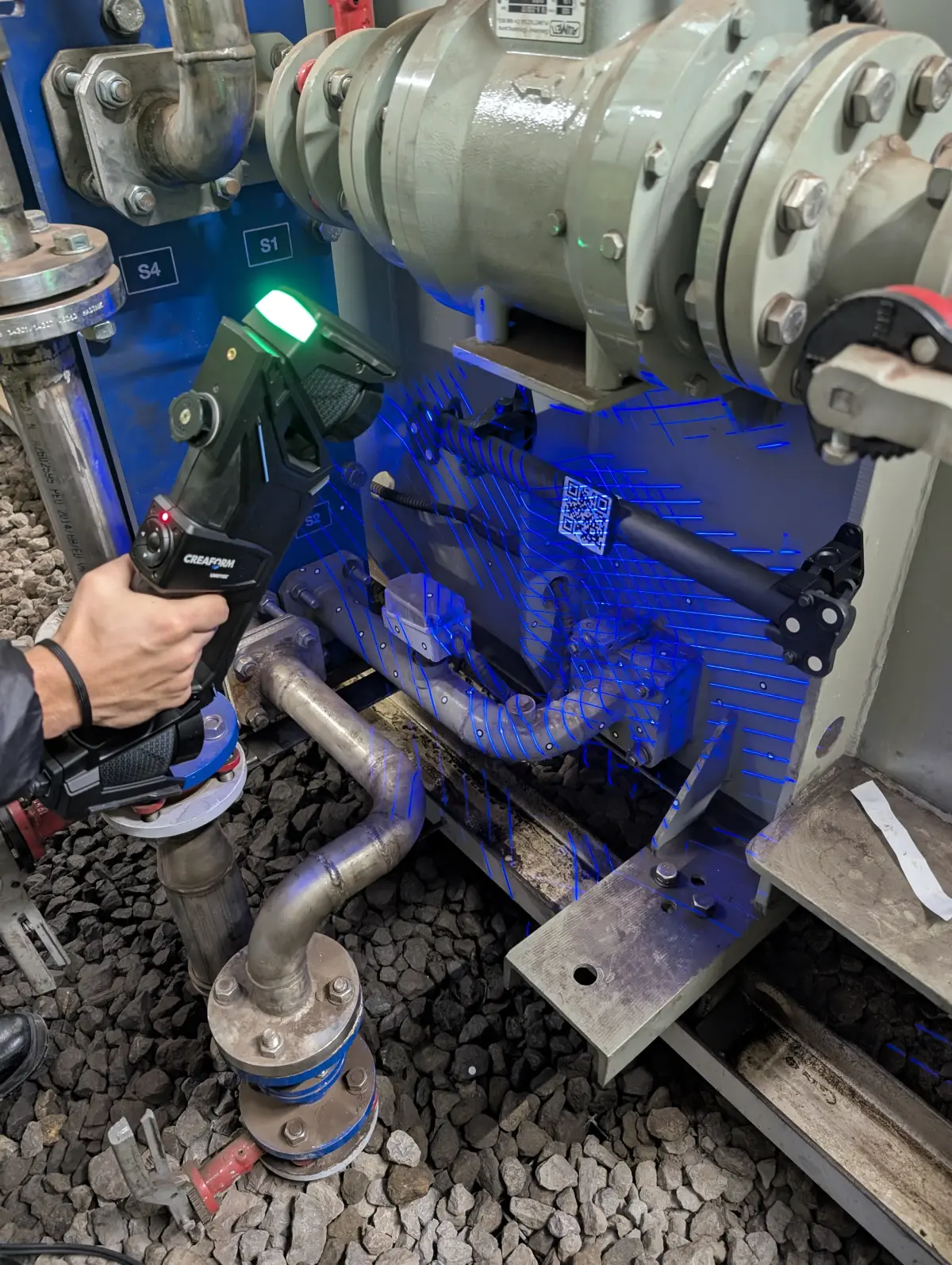
In handheld portable scanners —such as the Creaform HandyScan MAX we use at PROMECAD— the device projects multiple blue laser lines onto the part while the operator moves the scanner around the object. The system positions itself in real time using reference markers or natural geometric features, and builds the point cloud continuously. This type of scanner combines laser accuracy with the flexibility to scan parts of any size and in any location.
On the other hand, terrestrial laser scanners (TLS) such as the Trimble X7 capture millions of points from fixed positions, sweeping the environment at 360 degrees. They are used to scan industrial facilities, complete plants, large structures and architectural spaces. Their range extends from 0.6 to 80 metres, with accuracies of approximately 4 mm at 10 metres distance.
Head-to-head comparison
Below we break down the practical differences between both technologies in the aspects that matter most when choosing a type of industrial 3D scanner.
Accuracy and resolution
This is the point where there is the most confusion. The answer to what accuracy does an industrial 3D scanner achieve depends entirely on the specific equipment and working volume.
Desktop structured light scanners, in small volumes (field of view of 100-300 mm), can achieve accuracies of ±0.01 to ±0.05 mm. They are the kings of absolute accuracy for small parts: watchmaking components, dental parts, small tooling, electronics.
High-end portable laser scanners, such as the HandyScan MAX, achieve an accuracy of ±0.15 mm with 0.04 mm resolution, and can scan parts from a few centimetres to several metres. They do not reach the extreme resolution of a desktop scanner for tiny parts, but they offer more than sufficient accuracy for the vast majority of industrial applications (machining, casting, tooling, dimensional control) with unmatched versatility.
Terrestrial laser scanners have accuracies of several millimetres, appropriate for architecture, facilities and Scan to BIM projects, but not for part metrology.
Capture speed
Structured light scanners capture millions of points per projection in fractions of a second. In desktop mode with a turntable, a small part is scanned in 2-5 minutes. However, if the part is large and requires multiple positions, the process slows down because the scanner or part must be repositioned and captures aligned.
Portable laser scanners capture continuously as they move around the part, with capture rates of hundreds of thousands to more than one million points per second. For medium and large parts, they are usually faster in the overall workflow because they do not require setups or manual realignments.
Optimal part size
This is a determining factor when deciding which industrial 3D scanner is best for your specific case:
- Very small parts (less than 10 cm): Desktop structured light. This is where this technology shines with the highest possible resolution. A desktop structured light 3D scanner for small precision parts is the reference.
- Small to large parts (10 cm to 5+ metres): Handheld portable laser. The natural working range of equipment like the HandyScan MAX. It covers most industrial applications.
- Facilities and large structures (buildings, plants, piping): Terrestrial laser scanner (TLS). A 3D laser scanner for large structures like the Trimble X7 is designed for this, capturing entire spaces from stationary positions.
Performance with difficult surfaces (reflective, dark)
Both structured light and laser have difficulties with highly reflective surfaces (polished chrome, unanodised aluminium, mirrors) and with extremely dark or absorbent surfaces (black rubber, certain dark plastics).
In practice, the standard solution is to apply a temporary matte developer spray (titanium particles or similar) that creates an opaque layer of microns in thickness, does not affect the part's geometry, and is easily removed with a cloth or compressed air. The latest generation blue laser scanners —such as the HandyScan MAX— handle certain semi-reflective metallic finishes better than older red laser models, reducing the need for preparation in many cases. But on extreme surfaces (mirror, bright chrome), preparation is still necessary with any technology.
Portability and on-site use
Here the difference is clear. Handheld portable laser scanners are designed to go to the part, not for the part to come to the scanner. They connect to a laptop and can be used on the shop floor, on-site, in the workshop, or in the field. They are the natural choice when the part cannot be moved (installed machinery, structures, large-sized components).
Desktop structured light scanners need a controlled environment: stable lighting, absence of vibrations, and the part placed on the platform. Portable structured light versions exist, but in general, handheld laser scanners are more robust and adaptable to real industrial environments (dust, vibrations, varying light).
Equipment and service cost
The cost of an industrial 3D scanner varies enormously. Desktop structured light scanners range from a few thousand euros (basic desktop models) to over 50,000 euros (high-end metrological systems). Professional portable laser scanners range between 30,000 and over 100,000 euros. Terrestrial scanners like the Trimble X7 are in a similar high-end range.
If you do not need to scan every day, hiring an external 3D scanning service is usually the smartest option economically. The service cost depends on project complexity, not equipment price. In our industrial 3D scanning pricing guide we explain the factors that determine the budget.
| Criterion | Structured Light (Desktop) | Portable Laser (Handheld) | Terrestrial Laser (TLS) |
|---|---|---|---|
| Typical accuracy | ±0.01 to ±0.05 mm | ±0.05 to ±0.15 mm | ~2 to 6 mm (at 10 m) |
| Ideal part size | 1 cm – 50 cm | 5 cm – 5+ m | Facilities and buildings |
| Portability | Low (controlled environment) | High (on-site use) | Medium (tripod, stationary) |
| Speed on large parts | Slow (multiple captures) | Fast (continuous capture) | Fast (complete sweep) |
| Equipment cost | 3,000 – 60,000 € | 30,000 – 100,000+ € | 50,000 – 120,000+ € |
When to choose structured light
Structured light is the best option when these conditions are met:
- Very small parts requiring extreme resolution: watchmaking, dental, jewellery, electronics, micro-tooling components. If you need resolutions below 0.02 mm, a desktop scanner is your best option.
- Laboratory or metrology room environment: when you can control lighting, temperature and vibrations, structured light performs at its best.
- Repetitive production series: some structured light systems integrate into production lines for automated dimensional quality control of small parts.
- Texture and colour: many structured light scanners capture high-quality photographic texture, useful for heritage, product design or visual documentation.
When to choose laser
Laser technology is preferable when:
- The part is installed and cannot be moved: machinery on the shop floor, mounted moulds, large-sized components. The portable laser scanner goes to the object.
- The size range is variable: if today you scan a 20 cm part and tomorrow a 3-metre one, a handheld portable laser covers the full range without changing equipment.
- The environment is industrial: dust, vibrations, variable lighting, confined spaces. Portable laser scanners are designed to work in these conditions.
- You need to scan complete facilities: industrial plants, production lines, engine rooms. A terrestrial scanner (TLS) is the right tool for capturing millions of cubic metres in a few hours.
- Reverse engineering of industrial parts: for most reverse engineering with 3D scanning projects, the accuracy of a high-end portable laser is more than sufficient.
What technology PROMECAD uses
At PROMECAD we work with laser technology in our two scanning devices:
- Creaform HandyScan MAX (portable blue laser): for 3D scanning of industrial parts. Accuracy of ±0.15 mm, resolution of 0.04 mm. Covers parts from a few centimetres to several metres. We use it for reverse engineering, dimensional control, digitisation of tooling, moulds and all types of mechanical components.
- Trimble X7 (terrestrial laser scanner): for 3D scanning of facilities, industrial plants and large infrastructure. Range of 0.6 to 80 metres with approximately 4 mm accuracy at 10 metres.
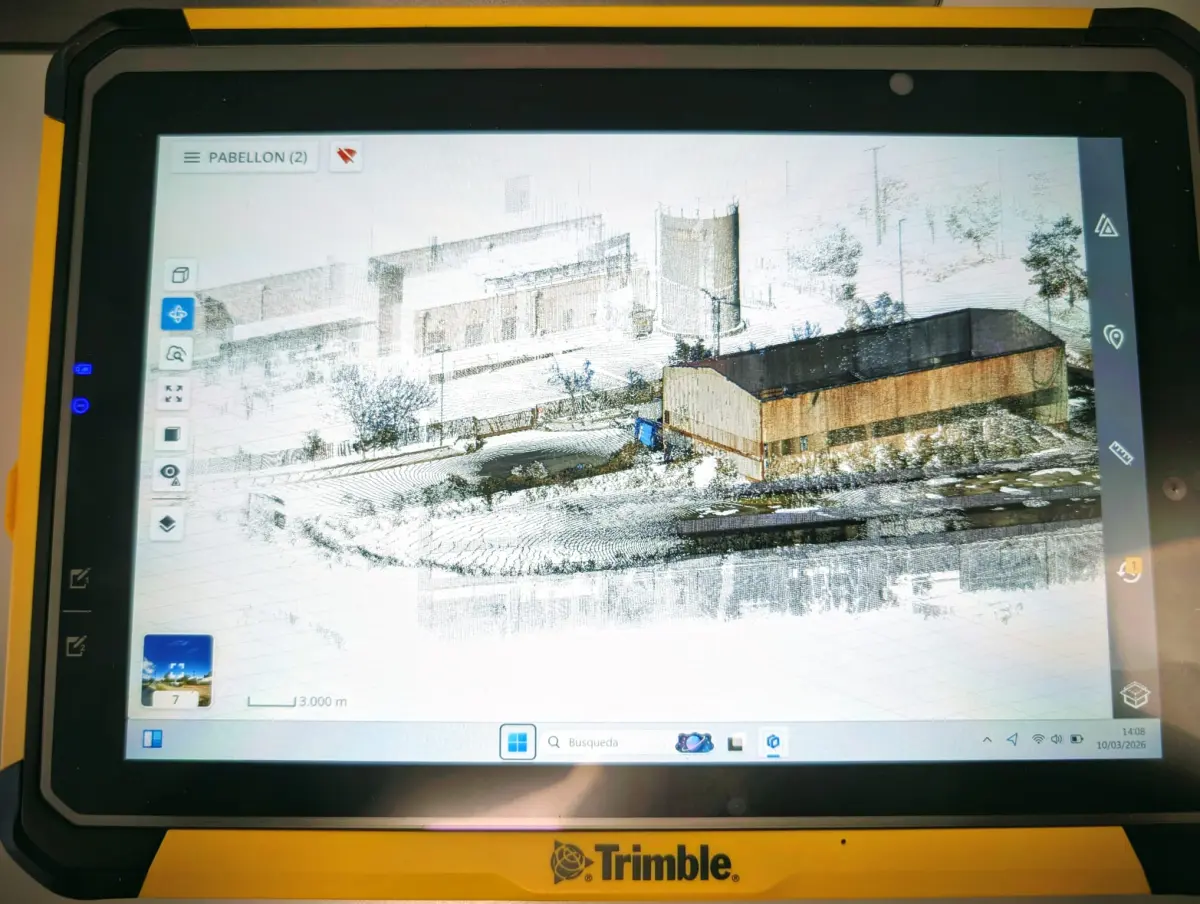
We chose laser technology because it covers virtually all the industrial applications our clients demand: mechanical parts, tooling, injection moulds, facilities, structures. The versatility and portability of laser are fundamental when most of our work is done on-site, at the client's facility.
That said, we are honest: if a client needs to scan parts of just a few millimetres with micrometric resolution —for example, micro-electronic components or dental parts— we will recommend seeking a service with a desktop structured light scanner, because it is the right technology for that size range. Our job is to ensure each project is solved with the best tool, not with whichever one we have at hand.
Frequently asked questions
What is the main difference between a structured light and a laser 3D scanner?
A structured light scanner projects fringe patterns onto the surface and calculates the geometry from the deformation of those patterns. A laser scanner emits a laser line or point and measures distance through triangulation or time of flight. Structured light typically offers higher resolution for small parts in controlled environments, while laser is more versatile for portable use, large parts and real industrial environments.
What accuracy does an industrial 3D scanner achieve?
It depends on the equipment. A high-end portable laser scanner like the HandyScan MAX achieves ±0.15 mm with 0.04 mm resolution. Desktop structured light scanners can reach ±0.01-0.05 mm in small volumes. Terrestrial scanners (Trimble X7) offer approximately 4 mm at 10 metres, designed for facilities rather than part metrology.
Which type of 3D scanner is best for small precision parts?
For parts of a few centimetres requiring extreme resolution (micro-components, dental, jewellery), a desktop structured light scanner is the best option. For medium-sized industrial parts where sub-millimetre accuracy and portability are needed, a high-end handheld laser scanner is more practical and versatile. The key is the part size and the required level of resolution.
Can a laser scanner capture reflective or very dark surfaces?
Highly reflective and very dark surfaces are a challenge for both technologies. The standard solution is to apply a temporary matte developer spray that does not damage the part. The latest generation blue laser scanners handle certain semi-reflective finishes better, but on extreme surfaces (polished chrome, mirror), preparation is still necessary with any type of scanner.
Ask us which technology is best for your case
If you have a 3D scanning project and are not sure which technology you need, tell us about your case. We will tell you which type of scanner is most suitable for your part or facility, and give you a no-obligation quote. If what you need falls outside our equipment range, we will tell you with complete transparency and guide you towards the right solution.
You can write to us from our contact page or call us directly. We respond within 24 hours. And if you want to know what happens after scanning —how to go from point cloud to CAD model— check our complete guide on the Scan to CAD process.